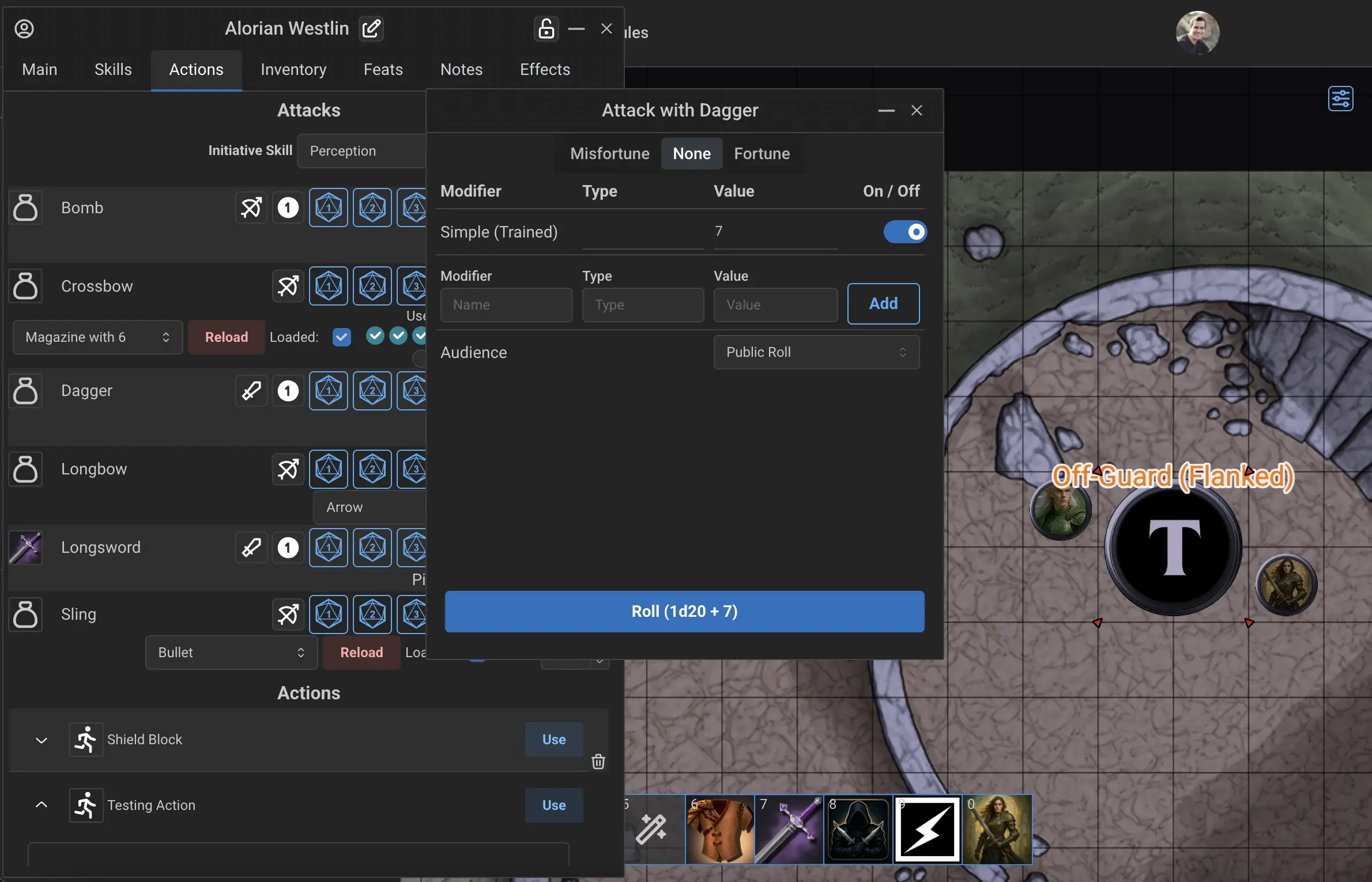
Hi everyone! I just wanted to give a quick update about what we've been working on at Realm VTT. While we continue to test and improve the platform for our existing systems (including Dungeons and Dragons 5th Edition), we have been hard at work on implementing Pathfinder 2nd Edition.
For those searching for a way to play Pathfinder online with a modern virtual tabletop, this is the update you have been waiting for. Realm VTT is building a full-featured Pathfinder 2e VTT experience from the ground up, and we want to share where things stand.
Why Pathfinder 2e?
Pathfinder 2nd Edition has grown into one of the most popular tabletop RPGs in the world, and for good reason. The system offers deep character customization, a tightly balanced action economy, and a wealth of published content. The community around PF2e is passionate, creative, and growing fast.
Despite that popularity, options for playing Pathfinder 2e on a virtual tabletop are still limited. Most platforms treat PF2e as a secondary system, with automation that feels incomplete or bolted on. We wanted to change that by building a Pathfinder 2e VTT implementation that respects the depth of the rules and feels native to the platform.
What PF2e Implementation Involves
This is a huge effort, as the system has matured quite a bit since its release and it is quite a bit more rules-heavy than other systems. We're trying our best to ensure that the implementation does justice to the ruleset (which we're also a huge fan of) while also being familiar in implementation to those coming from other VTTs.
Here is a look at the major components we are building:
- Character sheets. PF2e characters are complex. Ancestry, heritage, class, subclass, feats at nearly every level, skill proficiencies across a granular scale -- the character sheet needs to handle all of this cleanly. We are building a sheet that surfaces the right information at the right time without overwhelming the player.
- Action economy automation. The three-action system is central to PF2e gameplay. Our implementation tracks actions, reactions, and free actions so players and GMs can manage turns without manual counting.
- Condition and effect tracking. PF2e has a long list of conditions, many of which modify rolls dynamically. We are building condition tracking that integrates directly with the dice roller so modifiers are applied automatically.
- Spell and focus point management. Spell slots, focus points, innate spells, and cantrip heightening all need to work correctly. This is one of the more intricate parts of the implementation.
- Monster and NPC stat blocks. GMs need to be able to pull up creature stat blocks quickly and run them with minimal friction. We are importing data from the ORC-licensed sources to make this as comprehensive as possible at launch.
The Technical Challenges
Building a PF2e virtual tabletop is not a simple reskin of a D&D 5e implementation. The two systems share surface-level similarities but diverge significantly under the hood:
- Proficiency math. PF2e uses a proficiency system tied to level (Untrained, Trained, Expert, Master, Legendary) that modifies nearly every roll. This math needs to be embedded throughout the entire character sheet and dice system.
- Feat trees and prerequisites. Character options in PF2e are organized into complex feat chains with prerequisites. The character builder needs to validate choices and present available options correctly.
- Degrees of success. PF2e uses a four-degree success system (Critical Success, Success, Failure, Critical Failure) that many spells and abilities reference individually. The dice roller needs to calculate and display all four thresholds clearly.
Getting these details right is what separates a PF2e implementation that feels good from one that forces you to keep the rulebook open in another tab.
Where We Are Now
Currently, I think we're about 70% complete with the initial implementation, and then we need to bring over all the data that we're able to release per the Paizo Fan Content Policy. I believe that we're on track for a December release, so stay tuned!
The remaining work is focused on polishing edge cases, ensuring data accuracy across the imported content, and testing real gameplay sessions to catch issues that only surface during actual play.
What Comes After Launch
Following the release of Pathfinder 2nd Edition, we intend to test it a bunch out ourselves and ensure a good experience, as well as continued maintenance to try to stay on track for future updates. Beyond that, we want to also create a modified version of the ruleset to support Starfinder 2nd Edition.
Starfinder 2e shares significant mechanical DNA with Pathfinder 2e, which means much of the underlying engine work will carry over. The differences -- starship combat, technology-focused equipment, sci-fi ancestries -- are distinct enough to require dedicated work, but building PF2e first gives us a strong foundation.
Licensing and Content
We are of course going to continue to push hard to get official licenses so we can release content beyond what we're limited to by Open Licenses and Creative Commons. The ORC license gives us a solid starting point for core rules, classes, spells, and monsters, but official Paizo content -- adventure paths, setting-specific material, premium artwork -- requires a direct licensing agreement.
To get there we need your support! Please consider showing your support either via our Patreon, subscribing, or simply joining our Discord, Reddit, or Forum. A growing community is one of the strongest signals we can send to publishers that Realm VTT is worth partnering with.
Thank you to everyone who has joined us so far!